Filling a vacuum in a post-Brexit world with thoughtful centre-right political commentary from a senior political adviser who is founder of an international marketing and media relations consultancy.
It is fair to assess the NHS on pre-pandemic statistics. The NHS employs approximately 1.2 million people in England alone. In 2019/20, the Department of Health and Social Care spent £148.9 billion, 10.2% of GDP. Ex direct-pandemic spending, this budget will rise to £173.8 billion in 2022/23. It is a wonderful service staffed with many great people. They rose to the challenge of the pandemic brilliantly. Its very existence defines the UK. We should be proud of it.
Too much praise and not enough scrutiny is not healthy for the NHS
So, eulogies over, it is, like any other huge organisation, prone to errors and failure. Within the £148.9 billion there will be waste. Within the 1.2 million staff there will be lazy, self-interested, or incompetent staff. This is a fact of life not unfair criticism, and we should all be free to question the level of service we receive. After all, it is we who pay for it.
And we should be wary of activist medical staff and the organisations who represent them, who, in providing care when we are most vulnerable, avoid scrutiny as to their motives when campaigning. We should also be wary of the NHS being a political football too. This is in many ways inevitable, bearing in mind its importance to voters, but we should question the motives of politicians who laud the NHS without question, or pump money, or who wish to pump money, into it without the necessary accountability.
The catastrophic maternity care failures at the Shrewsbury and Telford NHS Trust are a reminder of not putting the NHS on an unquestioned pedestal. The findings are being well covered in the media but one of the stark findings was patients not being listened to, combined with a culture of bullying internally and mistakes not being investigated. Unforgiveable.
And there have been other scandals too; the Alder Hey organs scandal, the Bristol heart scandal and the Stafford Hospital scandal to name but a few. The latter was particularly worrying in that a Healthcare Commission enquiry found there was no cause for concern in the high levels of mortality at the hospital, only for a subsequent public enquiry to find there were multiple instances of neglect, incompetence and abuse of patients.
A failure to question the NHS also prohibits debate about its future. Should all healthcare be free at the point of delivery, are there ways some members of the public could be incentivised to use its services more efficiently? Why do some hospital trusts have a reputation for efficiency, even cutting waiting lists during the pandemic, whilst others do not? Not directly in the remit of the NHS but why do the services from General Practitioners vary so widely? Why is private healthcare being seen as a necessary option by growing numbers of the public? Many would argue that knowing what we know now, you would not start with an NHS as it is currently constructed. There are plenty of other efficient, effective, fair models of public healthcare in Western countries, as well as models that work less well.
You cannot repeat enough how great the NHS is in terms of its overall service delivery. But is it not perfect and we should not be intimidated into always lauding it. Ensuring it is not automatically placed on a pedestal is good for the NHS but, most importantly, vital for the patients who use it.
Patience was always thin with this charlatan of a Prime Minister. Loose with the truth, failing to understand the checks and balances of an unwritten constitution, reaching the highest of offices without knowing what to do when he got there, he has always been a high-risk office holder.
Surely his nine lives are coming to an end….
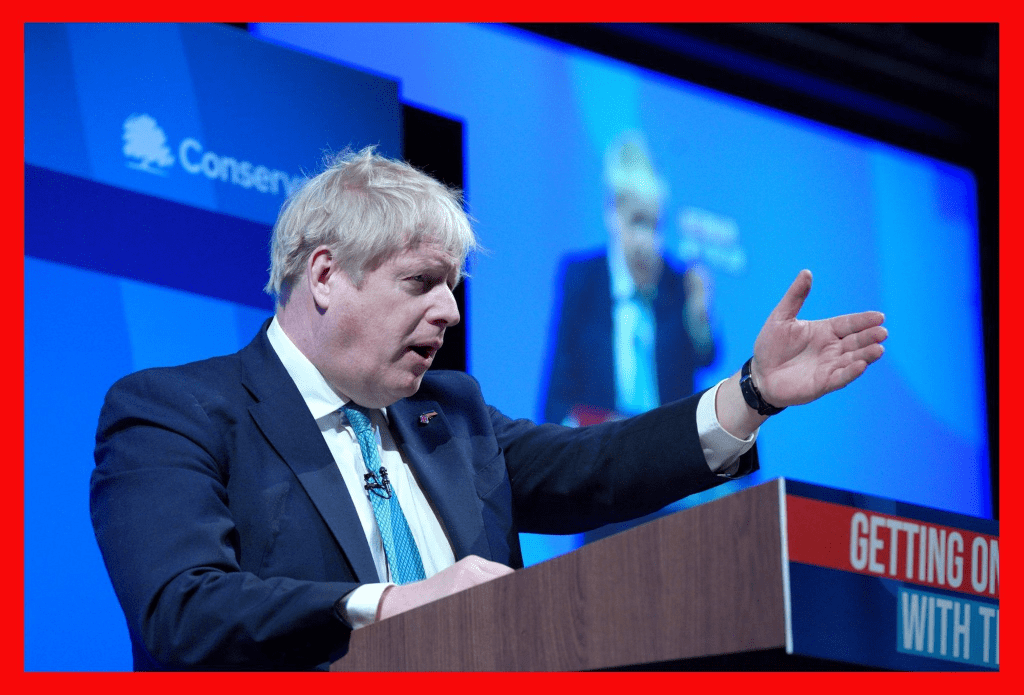
He has overstepped the mark again, one hopes for a final time, with his offensive comments at the Tories’ Spring Conference this weekend. He is quoted verbatim below:
‘I know that it’s the instinct of the people of this country, like the people of Ukraine, to choose freedom every time…When the British people voted for Brexit in such large numbers…it’s because they wanted to be free to do things differently and for this country to be able to run itself.‘
How crass this man is. Johnson seems unable to undertake his responsibilities, part of which are to heal the wounds of a divided nation and rebuild a new, constructive relationship with the EU, without careless ignorance. How could he equate the appalling war in Ukraine with Brexit? And ironies of ironies, how could he forget Ukraine is trying to join the EU, fighting for the freedom to choose to do so?
Watching the impressive Chancellor, Rishi Sunak, squirm on Sunday morning television when Johnson’s comments were put to him said it all. He was clear Ukraine and Brexit were not ‘analogous’ and the Prime Minister must have been misunderstood. He was not.
The fact that several senior Tories don’t have a problem with Johnson’s comments highlights one of Nigel Farage’s greatest achievements – turning the Conservative Party into the Brexit Party.
I am told wannabe prospective Tory parliamentary candidates cannot now progress if they display any historic Remain instincts publicly. You cannot get a job in Number 10, unless you are a Brexiteer. Good, able Tories such as Dominic Grieve, David Gauke and Rory Stewart are no longer members of a Party led by Johnson. He and his Tory followers seem to forget every recent Tory Prime Minister before Johnson voted Remain.
And turning back to Johnson’s broader political career, it is littered with irresponsibility. The recently released Nazanin Zaghari-Ratcliffe almost certainly owes part of her extended stay in an Iranian jail to Johnson’s earlier careless gaffes when Foreign Secretary. This current Prime Minister is the subject of a police investigation into breaking lockdown rules. He accepted contributions to a £200,000 renovation of his Downing Street flat, claiming he didn’t know of their source. He has brushed up closely to Russians with links to Putin and oligarchs generally in his desire to shovel money into the Tory Party’s coffers. He has repeatedly been caught misleading audiences on issues too numerous to mention.
The Tory Party has been one of the most successful political parties in history, to be fair also recently under Johnson. It has been so due to a core conservative, small ‘c’ philosophy which has been applied pragmatically to current events. Pragmatism has been lost on the issue of Europe and perhaps gone too far in accepting the lack of integrity of its current leader.
If Johnson’s overstepping of the mark with his Brexit/Ukraine comments was an attempt to distract from a looming cost of living crisis, it has failed. It only focuses attention on his personal failings. Public life, indeed the Conservative Party, would surely benefit if he was shown the door by either his parliamentary colleagues, voters, or both.
The news of casualties in Ukraine just gets worse. The madness of Putin gets madder. As this disaster unfolds it is almost impossible to find any grounds for optimism but there are ripple effects which will have longstanding consequences.
First, and of most immediate significance is the economic response of the West to this war. Expecting a wave of self-interested half measures, Putin has been entirely wrongfooted by the West rediscovering its sense of purpose. Serious coordinated sanctions which will decimate Russia’s economy have been implemented. The West has found its moral compass, even at the expense of potential problems such sanctions will cause at home. The test will be when the consequences for the public in Europe and North America mount, but one senses patience in the face of our very way of life being threatened by Putin’s actions.
The West has wholly wrongfooted Putin in its response to his aggression
Second, and running on from this, recalibrated defence and energy policies. Germany pledging to step up to the plate on defence spending, the UK, US and most significantly, the EU, pledging to wean themselves off Russian energy supplies, will remove Russia’s stranglehold over the West for a generation.
Third, the defenestration of the populist Right. How does Trump’s praise of Putin look now? Can you imagine if he was still President? How do apologists of Putin look in Europe? Begone Salvini in Italy, Marine Le Pen and Eric Zemour in France, to name but a few. One almost certain outcome is a victory for Macron in April’s French presidential election. The war has also driven Poland back into the heart of Europe and even Orban in Hungary is making the right noises.
Fourth, China. The last blog suggested war in Ukraine could be a catalyst/opportunity for China to join the heart of the international community. It caused vigorous debate! It was only a suggestion, not an expectation. But, regardless, the West’s economic response must be unsettling for Xi and should make him think twice about his shameless tactical embrace of Russia and any moves on Taiwan.
Fifth, the benefits of a free press. This war has been fought in public and endless Western news outlets have distinguished themselves hugely with their reports, busting apart sometimes ludicrous propaganda from Russia and its allies. In the end, this will have a key impact on ending this war and acts as a reminder to the previously complacent West never to take such news services for granted. It also means the sources of information in social media are now firmly in the public eye with much more scrutiny likely to uncover false information.
Sixth, and closer to home, this war shines a light on corrupt money infecting London, the property market generally and the financing of political parties (really the Conservative Party). Even Conservative commentators are warming to the idea of greater state funding of our political system to create a more level, fairer playing field and remove the temptations of donations from potentially corrupt businessmen and/or unfair access to the honours list…That would be a very good thing.
What Ukrainians are going through is unimaginable and much more can still be done to ease their suffering. Of course, only Putin can end this war but his unintended legacy, for he will not survive his psychopathic act, has been to strengthen the West by ending its complacency and giving it purpose. Very sadly, it has come too late for Ukraine today, but possibly not for future actions by other dictators and their allies.
The invasion of Ukraine is so tragic, so pointless and so self-defeating, words fail commentators. Surely it marks the end of Putin and Russian expansionism in the medium term. But the shorter-term costs will sadly be enormous.
But turn to China for a moment. They are playing a fairly clever hand. Abstaining in the UN, offering to mediate, criticising the invasion but also Ukraine joining NATO, they are just about holding their own.
A new type of opportunity for China…
But not for long. They will have to get off the fence. Trust in China is very low, and the West is hardening its stance against those who threaten its democratic future…finally.
Could this be China’s moment to reposition itself? President Xi Jinping must realise Putin is an unstable ally unlikely to recover from his disastrous Ukrainian venture. He must also realise that the West can wreak untold economic havoc if they remain united. China’s success story is all about growth. Imagine if this was put in jeopardy by an attack on Taiwan for example?
China could be really smart by dropping its default bellicose behaviour, instead extending its influence through a new, mature, more sophisticated approach to international affairs, which allows them to move closer to the heart of the international community.
Imagine. Putin oversteps the mark one last time and China joins the West in condemning Russia at the UN. It would also have the additional advantage of stealing a march on arch regional competitor, India, whose nationalist Prime Minister, Modi, has appalled observers by his equivocation over the invasion. China starts to court Taiwan and indeed the people of Hong Kong, not threaten them. China reduces tensions in the South China Sea. China, without apology, makes quiet concessions on the treatment of the Uyghurs, subtly acknowledging a new balance between security and human rights.
One accepts this may seem too naïve and idealistic in such grim times. But it would mark China’s coming of age as a self-confident international community member. It would be smart politics by shaping events further through wholly constructive actions.
One can only hope. And as we watch war unfold brutally in Europe, that is all we have just now.
Madness, madness, madness. The invasion of Ukraine could prove the end of Putin in the medium term, but the price paid today by Ukraine and its allies will be huge.
Time for the West to regain its purpose in the face of ruthless anti-democratic aggression
Why has Putin done this? Ukraine will be a drain on Russia for a generation and one sincerely hopes a more formidable longer-term enemy than many of its people suspect.
It is almost certainly about Putin’s legacy. Angry at the dismantling of the USSR and the West’s attitude to Russia generally (not always smartly handled), his well sign-posted objective is to rebuild Russia’s former empire and sphere of influence. He also seems in a hurry. His demeanour appears strange, he walks oddly and there have been persistent rumours of Parkinson’s disease. Perhaps his window of opportunity is a personal one not simply military.
And the West? Its frequent greed, lack of unity, lack of confidence, lack of purpose and understanding of the need to defend democratic principles both at home and abroad has contributed to Putin’s actions. Populism, with Trump only this week calling Putin’s aggression against Ukraine as ‘genius’, ‘wonderful’ and ‘very savvy’, has been a major contributor but so have other actions such as the courting of China for economic advantage and the acceptance of corrupt money washing through the West’s financial structures. Here in the UK, Chinese and Russian money coursing through the property market, tainting British politics in the process, has been a disgrace.
Putin’s invasion of Ukraine should shake the West’s complacency and force a resetting of its purpose in pursuing and defending democracy. In this there are grounds for a sliver of optimism in these bleak times and the actions required are many, short and long term.
First, there should be total unity in the West’s opposition to Putin with overwhelming financial support and the provision of weapons to Ukraine, whatever the response from Russia, of course if it is not too late. Crushing economic sanctions too on a fragile Russian economy. No more independent diplomatic initiatives (Macron) or diplomacy at all. The latter has failed, and Western governments have promoted hope over experience in dealing with Putin for too long.
Second, it should be made clear that a single attack on a NATO member is war, whatever the consequences. We cannot let a corrupt iron curtain descend on Europe again.
Longer term, the implications for this invasion are wide-ranging. Europe must now pay up more fully for its own defence. This has been a source of legitimate concern and criticism from America. The EU also needs to unify around a more coherent and consistent collective defence and security policy, having mismanaged it to date. A single European armed force in coordination with NATO, no longer the concern of the UK, has to be under consideration even if today the EU’s disfunction makes it more of an aspiration. This in turn provides a route for the UK to forge a new relationship with the EU on defence and security grounds alone.
Time also for a new European energy policy. Reliance on Russian gas has surely been a huge and predictable strategic mistake. Merkel’s pointless decision to end Germany’s nuclear power capabilities will be seen to have been a disastrous legacy from her chancellorship.
Lastly, and crucially, the West should tackle its own compromising greed with immediate effect. No limit on economic sanctions whatever the price in the face of aggressors, however powerful. No dirty money in Western finance and politics. No compromise in trading democratic principles for ongoing trade with China for example and a total commitment to defending the independence of Taiwan. If there is an economic price to be paid by people in the West, so be it. It is the job of politicians to explain why and gain acceptance for any painful fallout.
It is a depressing day. Just as the threat of Covid finally starts to recede a new global disaster threatens to overwhelm us. But if the West cleans up its act in defending democratic principles through concrete and constructive actions, Putin’s aggression may provide a route for the West to recover its purpose. And not a moment too soon.
The greased piglet, as Johnson is unpleasantly nicknamed, has done it again. At first sight, and it is only first sight, there is not quite enough in Sue Gray’s report to remove him, and the moment of maximum danger has passed for the time being. The Metropolitan Police have some responsibility for this. Their confused, belated response in deciding to undertake a criminal investigation into parties at No. 10 on the cusp of the report’s publication has dulled its impact. It should surely mark the end of Metropolitan Police chief, Cressida Dick’s career. Her nine lives are over.
A temporary reprieve only…
In the meantime, Tories, even this lot, know how dangerous it can be to try and remove a wounded sitting Prime Minister who is still standing. The trauma of a no confidence vote and/or a leadership contest can derail a Party in office, particularly when there is no clear successor. There is still a pandemic to fight, let alone a cost-of-living crisis and potential hostilities on the Russian/Ukrainian border. Tearing the government apart now with Johnson digging in would look self-indulgent at best, hugely irresponsible at worst.
But be in no doubt, the findings of this report are damning. Johnson’s premiership was always going to be a high wire act. The chaos surrounding this most amoral and unTory of Tory Prime Ministers was well sign-posted. However, his unique public persona (albeit a fake one from reality) and campaigning style also allowed him to reach parts of the electorate Conservatives normally find hard to reach. His job was to see off Corbyn and get Brexit done. Mission accomplished.
In the light of these revelations, the very traits that have carried Johnson’s political career to date now look like a millstone round his neck. Loose with the truth, a belief that rules apply to other people, poor attention to detail, chaotic in his private life, climbing to the highest of offices without any guiding philosophy except to reach and stay on top make his continued leadership a disaster.
The public everywhere cannot forgive and forget the parties in Downing Street. It has ‘cut-through’ as they say even though the blatant conflicts of interest surrounding the funding of the redecoration of Johnson’s Downing Street flat often seem a more serious long-term threat to good governance. Voters are angry, as every opinion poll confirms, and Johnson’s dishonest, wayward personality traits will be seen through the prism of this emotion. There is plenty of fodder for his long-standing opponents but now also to new Tory and floating voters alike and it will be this that does for him in the end.
And if Johnson clings on, those in Cabinet seeking to replace him will be tainted by his reputation. Theresa May’s intervention in parliament today about the lack of integrity at the heart of Downing Street was brutal and impressive in its frankness. Would any Cabinet member have the guts to share these same sentiments in public? Highly unlikely.
Turning briefly to Labour, Starmer’s Opposition is not the calibre of Blair’s Opposition, although Starmer himself is gaining authority. Labour do not have Scotland either and a vote for them will be open to the accusation it lets the SNP into UK government by the back door. Combined with a lack of bounce back from the LibDems, a hung parliament is still likely under Johnson or indeed any successor. But what a fall from grace. The Tories were all but certain to win a 2023/24 General Election. No longer.
‘Red Wall’ Tories are angry, more liberal Tories in the south disillusioned by this government’s populist stance. Johnson’s strength was being the best of both worlds electorally. Now he is the worst of both worlds. The damage has been done however long he holds on and rightly so.
Each January political predictions are made for the year ahead. Rarely do commentators revisit past forecasts mainly because people hardly remember them and they are, inconveniently, similar to those of most economists, frequently wrong.
This modest blog with limited, albeit growing readership, has to rake over last year’s predictions to cling on to credibility despite the adage you are only as good as your next forecasts…
So how does the 2021 scoreboard look? Well actually quite good. Eight predictions were made of which six were correct, one partly correct and one still work in progress. None were wrong. Phew!
It is difficult to believe Johnson was master of all he surveyed at the start of 2021 despite the raging Covid pandemic. There was no real threat to his leadership, only rumours that having delivered a full Brexit he may leave the premiership asap to spend more time with his bank balances. This blog disagreed. It forecast that Johnson would go nowhere in 2021 whilst Covid dominated, and his ego drove him to more ‘historic’ actions including reaping the benefits of a supposedly joyous Brexit. However, there would be growing restlessness at his style of leadership and overall incompetence and the seeds would be sown for another game changing political career to ultimately end in failure. Correct.
No Scottish independence referendum or even the promise of one. Correct. This will not happen in this parliament under Johnson or any other Conservative leader.
The next forecasts were on US politics. Biden would be more radical than expected in domestic policy, foreign policy would barely depart from the Trump era and Trump would be a busted flush. Mostly correct. The disappointing Biden has certainly tried to be radical domestically even if one West Virginia Democratic senator has stymied his US$1.75 trillion ‘Build Back Better’ spending Bill. Foreign policy has largely followed Trump, specifically in relation to Afghanistan (where was the promised cooperation with allies?) and China. Trump has been side-lined despite his depressing sorry hold over today’s Republican Party. More on all this later.
On European politics, Macron would try, almost succeed, but ultimately fail to seize Merkel’s mantle of leading Europe. Correct. German political stability reigns and therefore so does its dominance through a Social Democratic led alliance with the continuity chancellor, Olaf Scholz, at its head. Draghi in Italy has outshone Macron in maturity and Macron’s increasingly petulant actions against the British et al to seek re-election has diminished him.
Next, the spotlight on the power of social media companies would intensify with new political initiatives to curtail their power. Work in progress into 2022 and beyond.
Lastly, Covid would dominate the political landscape throughout the year. Sadly correct.
So how does 2022 look? Predictions on likely events this year are tricky as there is nowhere to hide. Key outcomes are absolute. Gulp! Here we go…
2022; a year of absolutes…
This has been re-written twice already since yesterday! Putting aside any preferences this blog may have…Boris Johnson seemed likely to survive throughout 2022. Febrile speculation that his premiership had six months to go and that he would be ousted after the local elections felt wide of the mark. Johnson has no real successors; he would smarten up his act (cue new 2022 haircut…) and his calculated gamble on Covid restrictions would just about succeed. Yes, the economy looks fragile on the cost of living front and lights are flashing amber for him as the Labour Opposition is a little stronger and his backbenchers continue to revolt. But think about it. Mooted successors are Liz Truss (loved by the grass roots, loathed by colleagues, no perceived election winner), Rishi Sunak (currently too tied to Johnson) and Jeremy Hunt (a grown up with insufficient charisma). Oh dear. He would just about manage to strengthen his core team to avoid further No. 10 debacles and, as for Labour, they should be 20 per cent ahead not 5-6 per cent. What they stand for still lacks any sort of clarity in the eyes of voters.
One proviso, however. Johnson had to avoid any more scandals or existing ones developing for the logic of this analysis to apply. Incredibly events are deteriorating swiftly as details of further Downing Street lockdown parties emerge. Until this week, he looked likely to lead the Tories into what now looks a more likely 2024 general election but his ability to self-destruct in the highest office should never be underestimated…His future is in the balance. In the short-term, he will still probably survive because he always does but this is a far more reckless prediction than it seemed just a few days ago. He has lost what little moral authority he had, and the Tories will look to replace him ahead of the next election.
In the US, the Democrats will get a pasting in the November mid-terms. Biden will be a lame duck, but the future does not lie in a resurgent Trump but rather a more political, calculating far-right Republican who, in many ways, will be more threatening than Trump. The Democrats, hopelessly split, will not settle on the also disappointing Kamala Harris as Biden’s successor so the US political stage will remain ill-defined in 2022 until leading future presidential candidates emerge more clearly. All this will exacerbate the depressing partisan divisions engulfing the nation. It really does feel like we are watching the beginnings of the end of an empire.
Macron will win the French presidential election in April. The far right is split and the near right’s candidate, Valerie Pecresse, is not established enough. European politics will remain stable despite spats with East European states (watch the Hungarian parliamentary elections in April closely to see if populism there maintains its resonance). Germany and an improved Italy under Draghi will clip Macron’s wings. One bright spot might be an improved UK/EU relationship post the French elections.
In terms of major political elections, that only leaves Brazil and I confess I have no idea of its future post the October presidential race except for the likely demise of the vile Bolsonaro which must surely be a good thing.
And finally, China will continue to increase its global dominance in the face of a divided America, and relatively weaker Europe. Russia will not invade Ukraine. Such a threatened gamble is a sign of Putin’s weakness not strength. However, it will pay off in undermining NATO’s resolve (and raison d’etre) to push its diminishing influence eastwards.
So Happy 2022 to all readers. This may at least be the year Covid loosens its grip on global events and that, if nothing else, is a reason to be optimistic.
There have been several requests from readers about how they can access this blog directly. Please go to http://www.insiderightpolitics.com and sign up. It only takes a few seconds to ensure content is delivered to you in an instant! You can also follow me on Twitter: @insiderightblog.
Incredible. Speaking to senior Tory MPs at the weekend, they think Johnson is done for and give him six months at most. Spreading faster than this depressing and worrying Omicron virus, the decay around him is everywhere. Chaotic, not serious, not really understanding what being a Tory in government means, his colleagues have had enough. Johnson’s one saving grace was his election winning ways. These have deserted him. Not even a 60% Brexit voting North Shropshire was biddable to his former charms.
A grim end to the year…
And worst of all for the Tories, they are collectively tainted with sleaze and incompetence combined with the growing factionalism of liberalism versus lockdown. The resignation of the awful, self-styled British bulldog, Lord Frost, is a hammer blow to Johnson’s authority but also the unity of purpose this Tory government was meant to represent. Brexit is becoming so yesterday, even if its full impact has yet to be felt, leaving a vacuum in its place. And make no mistake about it. Those who voted for the chancer Johnson as leader must take full responsibility for creating this most unTory of governments. It was an accident waiting to happen with potentially dire consequences.
There is not much to amuse people nowadays but jokes at the expense of today’s administration is the easiest way to elicit a laugh. Its death may be a long time coming but widely shared ridicule is often fatal.
So Johnson’s relationship with his back benchers is irreparable, his collapsing reputation rightly dragging the whole Party down. With an open goal to aim at, Keir Starmer, a more serious man for serious times, may be gaining some credibility.
That just leaves the economy. Oh dear. Inflation has hit 5%, brutal tax rises kick in next Spring and more Covid restrictions risk derailing economic recovery. Standards of living are likely to fall and further EU single market barriers kick in next year too.
This blog’s analysis of what might bring Johnson down is proving correct but certainly not the timescale. And the poison has spread to the Tories as a whole as was always the danger.
Johnson, of course, could still survive. Febrile Tory back benchers, even senior ones, are not always the best guide to the future and the power of incumbency should not be underestimated. But ultimately, the long-term damage has been done.
But look forward to next year when Omicron is in retreat, a chastened Tory Party, possibly led by a grown up, raises its game in the face of a more confident and capable Opposition.
Politics in 2022? One could almost feel optimistic…
Have a safe and merry Christmas in these challenging times.
Our Company, JPES Partners, is mostly staffed by younger people. They have embraced the need to be vaccinated and several of us have had our boosters, but not in a Johnsonian ‘boosterism’ way…Throughout the pandemic their diligence in meeting client needs and keeping activities going successfully has been really excellent. Indeed heart-warming, as is their concern for colleagues and their families in these challenging times.
So it is with a heavy heart that we have decided to cancel our Christmas Party next week in favour of much more modest, socially distanced festivities. We simply do not want to expose employees unnecessarily to the dangers of having to self-isolate over the Christmas break. We all want to enjoy this time of the year avoiding, as much as possible, putting older relatives at any sort of risk. We have our Company offsite at the end of January and will reschedule it to then, hoping that the latest wave of this damn coronavirus is receding by this time.
These decisions were clear-cut. It feels like the best balance of common sense and keeping the show on the road. So, we ask ourselves, why is it so difficult for the Government?
What goes on behind this door is everybody’s business…
It is because there is a moral vacuum at the heart of this administration. As written many times before, Johnson sets the tone and he is a chancer, a rule breaker, for rules apply to other people not him. Economical with the truth but having connected with voters with his superficial charisma, he feels entitled to ‘wing it’. Well, that is not good enough and certainly not in a Prime Minister.
He is being found out through the actions of his staff and his own actions. It does not look pretty. Blatantly misleading statements about parties in Downing Street last December, the excruciating recording of a mock press conference addressing them, on top of the Owen Paterson affair and the funding of Johnson’s Downing Street flat is adding up to be quite a disaster. The government is losing its moral authority, just when it needs it to manage the Omicron wave of the virus. And the rot starts from the top.
Today, Downing Street cancelled its Christmas Party in a wholly inconsistent way to the alleged activities of last December. One doubts there were moral dilemmas in reaching this decision. It was simply a tactical ploy to try and pour water on indignant flames.
Too little, too late. It is time the Tory Party as a whole fully woke up to the flaws in the man leading it before voters do. Otherwise, there won’t be many future Happy Christmases for this Government.
This blog has consistently argued that another Johnson led General Election victory is highly likely. The Tories feel like the only game in town as Keir Starmer has limped on as a relatively honest but mediocre Labour leader and the LibDems mostly fade into the background.
Indeed, any straws in the wind to date hinting at Tory vulnerabilities relate only to Johnson himself, and his relationship with his backbenchers, not the Tories as a whole.
And yet…and yet…
One ingredient for a Labour revival is the credibility of the Labour front bench. Starmer botched the last shadow cabinet reshuffle providing his awful Deputy Leader, Angela Rayner, (directly elected so cannot be fired), with a factional victory of sorts. The end result was some minor improvements but not enough and Starmer looked weak in the process.
Where were the emerging or existing Labour Big Beasts? They needed to be front and centre to make progress. The first reshuffle mostly didn’t uncover them when they would have been of real benefit, particularly as the Tories are hardly overwhelmed in this department.
So, this week’s latest reshuffle is interesting. Yvette Cooper finally returns as Shadow Home Secretary (replacing the largely unimpressive Nick Thomas-Symonds), the highly economically literate Rachel Reeves stays as Shadow Chancellor with her authority enhanced, the sharp and, importantly, centrist northerner, Lisa Nandy, moves from the Foreign Office (off you go, the overrated David Lammy to this now backwater) to challenge Gove at the Orwellian ministry of Levelling Up. Then there is the shrewd Pat McFadden supporting Reeves at the Treasury and a rising star, Wes Streeting, goes to Health. An added bonus is that former leader, Ed Miliband, a reminder of past failings, has had his portfolio reduced. Not too painful but why doesn’t he go off and run a mid-sized NGO whilst his more talented older brother runs a larger one?
Labour moves its bigger beasts to the frontline
This is the reshuffle Keir Starmer always wanted and he has now got it. And it has just arrived as the Tories are wilting with a somewhat underpowered, accident-prone Cabinet.
In the last blog the three-pronged assault on Johnson’s, and possibly the Tories’ grip on power was unhappy Tory backbenchers, a faltering economy and Labour getting its act together. The latter two were not happening. With this reshuffle, Labour’s performance has the potential to improve, and the score has now moved from one out of three to perhaps one and a half.
The Tories, and Johnson in particular, should therefore start feeling a little nervous. Coronavirus, even Omicron style, is unlikely to provide enough distraction to avoid a decent challenge being noticed by voters from this now more talented Labour front bench.
There have been several requests from readers about how they can access this blog directly. Please go to http://www.insiderightpolitics.com and sign up. It only takes a few seconds to ensure content is delivered to you in an instant! You can also follow me on Twitter: @insiderightblog.


 Inside Right Politics