A gruesome cast lines up to oppose the Brexit deal

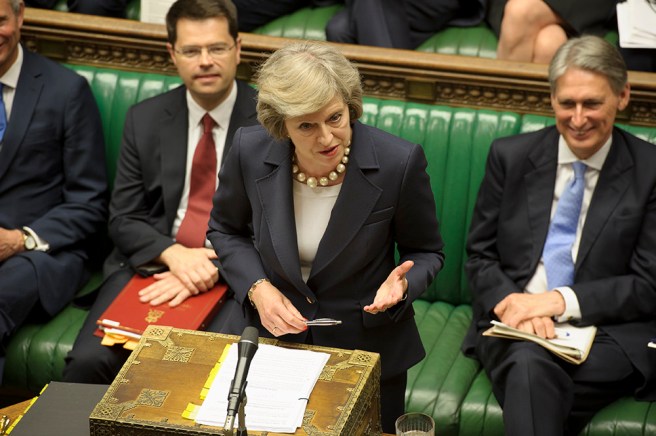
Look at the sorry cast so far; the DUP, Corbyn’s Labour Party, Boris Johnson, David Davis, Iain Duncan-Smith…the list goes on. And now Dominic Raab and Esther McVey. What happened to collective cabinet responsibility? None of them have really succeeded in their jobs or could be perceived ever to do so.

We will have weeks of grandstanding, tantrums and further resignations whilst the small issue of the country’s future hangs in the balance. But in reality will Theresa May prevail? The answer, if she gets through the next few days, is still probably.

And why? Because this deal is the best balance that can be achieved in the face of fierce fire from all sides.
28400547776_466541f0f7_b

Those at the heart of government know how serious a no-deal would be. It has been under-played to avoid seeming like another chapter in ‘project fear’ but the threats to supply lines, from industry to food and medicines, are very real, as is the damage which would be inflicted on the economy overall. The blasé dismissal of these threats by the hard Brexiteers is an abrogation of responsible government.

The deal that has been negotiated by the PM, as we currently understand it, buys sufficient time to allow those who support Brexit to deliver a clear plan with minimal disruption to the economy. Admittedly, there are hostages to fortune; but at this stage I would rather my captor was the EU than the sorry list of those above.

So what now? There could be more resignations and TM may be challenged for the Tory leadership. I trust she will decide to hold on but who could blame her if she said she has had enough!

If the Tories don’t implode in the next few days, the real battle will take place in the House of Commons. If the PM fails to get the deal through, she could resign or try again. A second failure would certainly lead to an interim Tory leader, a humiliating request to extend the EU departure date whilst there is a leadership election, and then a new Tory leader who would restart the clock. The least likely option is a General Election.  The Tories couldn’t stomach the possibility of losing.

However, the real pressure is now on Labour moderates in the face of Corbyn’s shameless approach to Brexit. Will they put the country’s future in the hands of sensible centre ground politicians, or the right and left-wing extremists on either side of them? The centre is where the electorate lies; it is where the country’s future lies. A General Election, or even a second referendum at some stage, will confirm this.

Meanwhile the time for compromise is over. It is time for ‘muscular moderation’ to reassert itself amongst the sorry mess called Brexit.

Weakness of the US Democrats confirmed

Nowadays, you go to bed on election night with a sort of dread of what you will wake up to in the morning. First Brexit, then Trump, followed by the Tories losing their overall majority in the 2017 General Election, giving the whip-hand to the hard Brexiteers.

So it was with a sigh of relief that I woke up this morning to the news that the Democrats had taken the House of Representatives in the US midterm elections. But it wasn’t good enough. The Democrats should have wiped the floor with this most divisive of presidents. The fact they didn’t just confirms deep frustrations with the quality of opposition to Trump.

trump-2546104_1920

In the Senate the Republicans gained Indiana, Missouri and North Dakota. There was evidence they would lose Florida but seem not to have done – it has gone to a recount. What is it about Florida?

My recent trip to the US brought home to me the dominance of the Trump agenda. It is about Him, economic nationalism and external threats such as immigration and unfair trade practices. He is everywhere and the Democrats are nowhere. Protest politics from the likes of Bernie Sanders and Elizabeth Warren are not enough when the economy is booming, there is a sense of injustice amongst many sections of the electorate, and race and immigration issues are demonised.

The Democrats need a new centre-ground agenda, a fresh faced leader and real fight. Sadly it won’t be the defeated Senate candidate for Texas, Beto O’Rourke, at least not yet…

So what happens now? Dangers lurk just as much for the Democrats as for the Republicans. Legislative gridlock beckons now the Democrats have seized the House of Representatives but this provides an easy target for Trump and could provide a launch pad for a 2020 victory. Plenty of other presidential incumbents using this tactic come to mind… Clinton and Obama to name just two…Meanwhile Trump can continue his controversial appointments including a slew of conservative judicial ones through the Senate unheeded.

The future of this divided nation is more uncertain than ever and the vicious level of debate takes place in the most benign of economic circumstances. Just imagine when the economy turns as it surely will under a burden of debt, rising interest rates and lack of much need legislative reform?

The US stock market is up so far today. Quite why I don’t know. It is clearly not an accurate predictor of the political risks ahead.


Never mind the Budget, what about the wildlife

Nothing on the UK’s Budget this week. It was well leaked and consequently boring. You just hope the Government doesn’t lose its reputation for prudence, which is the only really positive attribute it has left…

More important just now is analysis published this week by the Living Planet Report 2018, compiled by the Zoological Society of London and the conservation charity, WWF, concluding that humans are to blame for a staggering 60% loss of the world’s wildlife from 1970 to 2014, the most recent year for which data is available.

The list of damage done is depressing. Elephants in Tanzania down by 60% since 2009, grey parrots in Ghana down 98% since 1992 and Borneo’s orangutans down by 50% in just 16 years. These are just a few of the alarming statistics.

Jeff Mostert via Unsplash

‘Exploding human consumption’ is the culprit as palm oil, soy plantations, dams, roads and overfishing chew up vast tracts of wildlife habitat.

We have Trump in the White House tearing up international agreements, now Bolsonaro in Brazil who may allow even greater deforestation there and, to cap it all, China has just lifted a ban on rhino and tiger ‘remedies’.

Have we ever had a more irresponsible governing class globally, who seem to be racing to destroy the planet for the next generation? Great campaigns on global warming and removing plastic from the seas are something; but if world leaders don’t play ball more widely, we have no chance of improving our environment in all senses.

And where are young people in all this? If they cared enough and voted, they would be a force to be reckoned with in key democracies. We don’t need votes for 16 year olds. Just getting decent numbers of 18-24 year olds out to vote would be a start. If it is not too much of a stretch, there are similarities with Brexit here in the UK. Like Brexit, the disastrous impact of our actions on the environment and the wildlife we share it with disproportionately affects younger generations. We need a generation of activists. Get onto it!

In addition, the UN needs to be more aggressive, the EU bolder and, yes, governments more interventionist driven by the concerns of the electorate. The dire consequences of the race to ever cheaper food in western countries must be articulated. A laissez-faire approach is no longer an option. There isn’t the time.


Ten days in Trump’s America

Yes, it is Trump’s America. Over the past ten days, I have travelled from San Francisco to Milwaukee, Chicago to New York. Trump is everywhere, and that is his secret. Loathe him or love him, the media dances to his tune, rising to his bait or praising him lavishly. CNN makes no pretence of being the Democrat’s mouthpiece, likewise Fox News speaks for Trump. But it doesn’t really matter. All channels including social media follow Trump’s agenda anyway.

trump-2546104_1920

Politically, the Democrats are nowhere. They have no clear leader and no clear response to Trump. The only thing I can remember from them during my visit was Elizabeth Warren bizarrely issuing the results of a DNA test proving her claims to Native American heritage. Who cares? As the Democrats drift to the Left, overwhelmed with political correctness, Trump, cleverly advised, unfairly paints them as an extreme, ‘left wing mob’. They don’t help themselves by failing to seem relevant and the strategy galvanises Trump’s base.

Trump’s approval ratings in advance of the midterm elections have just hit a record high of 47%, fuelled by a booming economy, a ruthless focus on immigration and clever politics. Incredible after his behaviour over Brett Kavanaugh and a recent exchange of tweets on his alleged affair with Stormy Daniels. In relation to the former, mocking a woman who gave evidence on her sexual assault and, in relation to the latter, twitter exchanges making references to ‘horse face’, genitalia size and blatant accusations of lying. It should make the US public blush with embarrassment; but they have become immune to the drama and corrosive level of public debate. Trump’s initial response to the murder of  the journalist, Jamal Khashoggi, last week, even if less hypocritical than some US dealings with the Saudis, underpins his lack of moral compass.

Interest in the midterm elections is at a record high but that might not save the Democrats who currently seem on course to deliver a disappointing result against high expectations. Eight years of Trump are as likely as ever.

This is a great country but it feels a line is gradually being crossed on a number of fronts. The economy roars but debt is soaring. Courtesy of Trump’s tax cuts, latest figures suggest servicing this debt now comfortably exceeds $500 billion annually, up nearly 15% on the last fiscal year. This stores up enormous problems for the years ahead. Excess wealth and extreme poverty is widespread. This has probably always been the case but what is new is that any political consensus about the way forward has all but evaporated. Public discourse is often untruthful, vicious and demeaning. Few offer a consensual way forward to this nation’s growing longer term challenges.

Will America hold together? Almost certainly. It is the world’s only superpower (for now) and the vibrancy and energy that got it there is not easily dissipated even with a gridlocked political system and some appalling standards of public conduct. But to be fully certain, it surely needs a ‘political saviour’ to put the country back on course. The problem is that person or party is not currently visible.


Theresa May 1: Internal Opponents 0

Phew! Returning from the Conservative Party conference and watching Theresa May’s speech at my desk, with my heart in my mouth, it is now over: positive, optimistic, serious and well delivered. Supporters can now relax!

JS - Teresa May 1-0 blog

I didn’t agree with some of the content, particularly on Brexit, but there was some good stuff on domestic policy and it has bought the PM a little more time with the Party faithful. My, does she need it.

And what of her opponents? I am relieved to say that Boris Johnson blew it. His speech yesterday was obviously box office in a dull conference but many of the same people applauding him were back today applauding Theresa May. It was witty in part but long on objectives and short on solutions. It was like musical theatre; nice on the ear, entertaining, but with no definable substance. The growing irritation with Johnson from his parliamentary colleagues is what really matters and the recent photograph of him running through a field of wheat in parody of the PM to many was the final straw…

Nobody really wants the PM’s job before next March (except the former Foreign Secretary) and my betting is that she has another year or two. There is a strong consensus that Theresa May is a real trouper and deserves to be supported now but shouldn’t be allowed to lead the Tories into another General Election. That would still give her 4/5 years as PM and a chance to deliver Brexit. There are worse premierships.

Lastly, a few additional insights from Conference:

  • Graham Brady, Chairman of the 1922 Committee, which decides the leadership rules for leader, confirmed in conversation, that some MPs claiming to have submitted a no confidence letter to him on Theresa May have actually done no such thing!
  • The PM understands that a fudge to get Brexit over the line on March 29th with the real decisions being taken in the transition period is untenable. The uncertainty and damage to the economy would be too great.
  • A no-deal has really serious implications for supply chains and ministers say quietly there is no exaggeration in some of the dire predictions if talks break down. It drives the desire for a deal even if it requires further (limited) compromises.
  • Should there be a leadership election, in reality Boris is almost certainly a busted flush with his parliamentary colleagues. The next leader will come from centrists in the Cabinet; Sajid Javid, Jeremy Hunt (although his speech comparing the EU to the Soviet Union was poorly received) and possibly David Davis as a stop gap from outside the cabinet.

There you go. Theresa May survives and ends the conference a little bit stronger. Only a Brexit deal to deliver in a matter of a few weeks!


A solution to Corbyn: the Right must reform capitalism

‘Oh Jeremy Corbyn’ has spoken and it doesn’t sound good for those of us who believe in free markets. Fluent for him, with some witty lines, he took apart capitalism at his Party Conference claiming our economic system is broken.

JS - A solution to Corbyn

Indeed, there was a flurry of economic initiatives throughout Labour’s time in Liverpool and, uncomfortably, it reminded me of the 2017 General Election campaign. However impractical, sharply defined policies sounding superficially good were showcased, making the Tories, drowning in Brexit, appear flat footed. Umm…Ground Hog Day…

And those policy initiatives will resonate with many of the electorate. Taxes on the rich, massive increases in public spending, hundreds of thousands of ‘green’ jobs, extended childcare, workers on boards, wholesale nationalisation of utilities and a scheme to hand out 10% of the shares of big companies to workers. These policies could really fly and a Labour Government is not nearly as improbable as it should sound. The only firewall is a few DUP MPs keeping the Tories afloat. It all feels a bit precarious.

Of course the shear incompetence of the Labour front bench, the fact that nationalisation doesn’t work despite the failings of some privatisation structures, massive debts which will ultimately be paid for by the ordinary public, all mean many of these policies would be disastrous.

The first problem of course is that many voters don’t remember the chaos of a left-wing Labour Government. The second problem is more intractable; capitalism globally has failed in several respects over the past decade and is losing popular support.

A brilliant article by Martin Wolf in Wednesday’s FT summed it all up incisively. Inequality is rising across the West, driven by quantitative easing and inflated asset prices. Austerity is being borne by the poorest, global corporations avoid tax due to tax structures rarely crossing borders and excessive market liberalism, which caused the 2008 financial crash in the first place, has fuelled migration causing enormous tensions and the rise of populism.

Capitalism should be reformed and in the UK I would rather that was undertaken by the Right rather than the likes of Corbyn.

So what needs to change? As Wolf says, those who govern us should ‘promote a little less liberalism, show a little more respect for the ties binding citizens to one another and pay more tax’. Only in this way can we keep politics close to the centre ground and protect the social liberalism and democratic values that we take for granted.

There needs to be negotiations on comprehensive global tax structures. At home, subsidies favouring the rich such as higher rate tax relief on pension contributions need to end.  The obsession of cutting corporation tax has also run out of control. Planned further cuts should be frozen and companies also need to reform excessive remuneration structures. It is perfectly fair to reconsider reforming NI contributions for the self-employed too so that they are treated equally with other workers. Then there has to be comprehensive social care reform and a commitment to infrastructure spending in the North.

As for immigration pressures, they should be managed but the solution is not Brexit. It is at least a pan-European issue and we are walking away from the table at the very moment our influence is needed.

If there is any bandwidth outside the Tories’ obsession with Brexit, they need a radical agenda to reform capitalism that most of us can buy into. Otherwise Corbyn will do it for them and not in a good way.


EU overplays its hand

I am a Remainer. Always have been, always will be. But even I felt the urge to shout f**k off at the TV as I watched Donald Tusk give his statement that the Chequers solution for the UK’s departure had been wholly rejected by EU leaders at their summit in Salzburg. The language was blunt, Theresa May ambushed and dismissed. The attitude had arrogance written all over it.

JS - EU overplays its hand

The problem with those EU leaders driving an ever closer union is that they are out of touch with their electorates and certainly the Commission is out of touch with almost everyone. It has fuelled populism and provided an easy target for those advocating Brexit.

In treating Theresa May so badly, they continue to be blind to the consequences of their actions. It may fuel a rise in support for Brexit, and I suspect a rise in support for Theresa ‘the battler’ May. She came out fighting today and pictures of her isolated at the summit in a striking red jacket facing a gang of mostly white, bullying European male leaders will resonate with all sections of the British electorate. A People’s Vote should no longer be seen as a route back to EU membership. Well done Merkel and Macron…not.

However, the UK has always underestimated the strength of commitment of Germany and France to the EU as a political project. Our negotiators in advocating a Chequers solution which threatened this have made the same mistake again. A deal will probably still be done but don’t bank on it. Theresa May politically can’t budge from where she is and has thrown down the gauntlet to the EU. The EU will find it difficult to backtrack from here. There is either some brilliant acting going on or a ‘no deal’ is now a real possibility. Oh dear.

The obvious solution to this impasse is to join the European Free Trade Association a la Norway (see an earlier blog). This could be sold as stage 1 of a decisive break from the EU with an extended transition period leading to further escape routes from the EU’s embrace. Sounds like Michael Gove? Umm…what is this disastrous process turning us into…

The problem with this solution is that it crosses Theresa May’s foolish red lines and she would have to go. A General Election? Corbyn? None of these options are palatable to the Tories so for the time being we stay as we are. A ‘no deal’ is possible with really serious consequence for the EU as well as the UK and all because arrogant European leaders in Salzburg overplayed their hand.

The crash of 2008: lessons still to be learnt

It started with the collapse of Lehman and nearly finished with the end of capitalism as we know it. At the time it seemed every bank was about to go under and Alistair Darling, then the UK’s Chancellor of the Exchequer, made the staggering claim that we were 24 hours away from cash points running out of money to dispense.

Governments responded correctly in the end (even if they failed to regulate in advance) by pumping massive liquidity into the system to prop up the banks and keep the financial system afloat. Subsequent bureaucratic, but necessary, regulation followed; separating retail and investment banking, cleaning up balance sheets and raising capital ratios to name but a few initiatives.

So where are we now? Partly in a good place. The future of the global financial system has been secured (until the next time), asset prices have risen, steady global economic growth has been achieved and unemployment cut.

However, there are worrying consequences too and further lessons to be learnt. First, those consequences…

The massive quantitative easing (central banks buying bonds) has to be unwound and some estimates suggest the sums involved are in excess of $20 trillion. It has gone on too long with record low interest rates over a prolonged period causing pain for savers and worrying asset price bubbles. If a crisis were to occur tomorrow, a no-deal Brexit for example, there is no further fire power in central banks’ arsenal until policies are reversed.

Government debt has also soared, causing austerity measures that have acerbated the divide between rich and poor. All this sowing the seeds of the populist surge in politics we are seeing now.

The unfortunate consequences point to lessons still to be learnt. If capitalism is to succeed it needs to retain consensual support and that means implementing firm measures to encourage long termism in our financial system.

Disparity of wealth within companies needs to be tackled too. Executive pay amongst FTSE 100 CEO’s, for example, went up 11% last year to £3.93m whilst that of full-time workers rose 2%. The mean pay-out ratio between FTSE 100 bosses and their workers has been on a steadily rising trend, up from 128:1 to 145:1 in 2016/17 alone. Such inequality and the feelings of injustice that accompany them, have arguably led to Trump, Brexit and other challenging populist political consequences, all of which can be traced back to the events of 2008.

Here in the UK, policies across all arms of government are under review but so too is corporate governance, with a view to correcting key elements of short-termism and fairness in society. There is a massive opportunity for the City to play its activist part on a host of issues from executive pay to diversity issues and broader ESG initiatives, let alone helping to solve a growing savings and retirement crisis. No wonder the financial services industry is in the spotlight. How great it would be, Brexit allowing, if it takes the lead in learning the lessons of 2008..?

India provides a silver lining to dark clouds

The clouds of global politics just seem to get darker. The partly understandable but appalling drift to populism across continents continues relentlessly.

Trump lashes out as he is trashed anonymously by a senior White House adviser who outlines the sheer awfulness of his presidency. We are protected apparently only by the actions of White House staffers who, with ‘quiet resistance’,  work around the president’s ‘amorality’. Yet his popularity amongst core supporters remains undiminished.

In Europe, the Far Right advance with riots in the German town of Chemnitz. They are present in the anarchy of Italian politics and are predicted to make major gains even in traditionally liberal Sweden. They run or part run governments in Poland, Hungary and Austria.

In the UK, Putin continues his thuggery with the now proven attempted assignation of Russian nationals by his gangster State, killing a vulnerable British woman in the process.

And there is Brexit… Here we are, watching with growing incredulity, contingency planning for the stockpiling of medicines and food in the event of a no-deal EU exit, advocated by many in the Tory Party. The only opposition to the government’s reckless actions is the Labour Party, hopelessly mired in self-inflicted anti-Semitism and hard left ideological disputes.

Wow. Not even a week has gone by since the summer break!

But no further comment on all this for now…. There is little new to say until further events unfold.

So let’s focus on an immensely solid and heart warming silver lining that has gone fairly unnoticed.

India’s Supreme Court has just ruled that a colonial-era law criminalising homosexual sex is unconstitutional. This is a huge victory for the LGBT community who have battled to have this law overturned for 20 plus years. It also unanimously confirmed that India’s LGBT community has a fundamental right to equality, dignity, self-expression and privacy. Even Modi’s conservative inclined government chose to sit on the side-lines as the rulings were announced, leaving it to the ‘court’s wisdom’. This in the knowledge that popular opinion was supportive of the judgements.

So a nation with a population of 1.4 billion, almost certain to be a future super power, takes a great step forward in embracing equality and social liberalism. There are silver linings and this is a major one. Worth celebrating amongst the gloom.


Lessons from Down Under

Operating in a political bubble, MPs battle between themselves on the issues of the day. Social conservatives versus liberals, those tough on immigration versus those taking a more pragmatic approach. Ideologues versus pragmatists. Career politicians ruling the roost.

Such is the vehemence of the battle, they are prepared to oust their leader at the drop of a hat. No loyalty to the PM despite a constant placation of conservative critics. Just constant plotting. Even successful economic policies, which used to be the key to political longevity, mean nothing.

Such is the behaviour of the Conservative Party in the UK.

And then you have Australian politics…

Even more brutal than Westminster, MPs have ousted 4 PMs in 8 years, with no PM fulfilling a full three year term since 2007.

This time the centrist, liberal (with a small ‘l’) Malcolm Turnbull is replaced by Scott Morrison, a social conservative who opposed the same sex marriage bill. Ruthless on immigration, he will try and shore up the Government’s Liberal led coalition. Nobody asked for this new agenda except some pretty bitter, unpleasant back benchers.

And what is the cost of all these machinations? Vital legislation on energy use, including a much needed emissions trading scheme, has been ditched. This occurring even as Australia experiences its worst drought ever as climate change takes hold. Important policies on corporate tax and public spending have also gone nowhere.

But the real damage is to the esteem in which politicians are held by the voting public. They watch with disgust as they see games being played at the expense of solid policy achievements. The walls of the political bubble just get thicker, fuelling frustration and the rise of populism.

This is what is happening in Australia. This is what is happening in Westminster.

In the UK, the Tories scrap over Brexit, with ministers forced to make incredible statements on potential food and medicine shortages in a ‘no-deal’ scenario. The economy remains strong but is increasingly being weakened by uncertainty. Vital social care legislation, infrastructure investment and a raft of other key policies are on hold as Brexit takes up all the policy bandwidth. The sop of a further £20 billion of unfunded expenditure on the NHS barely registers through lack of credibility.

The PM is constantly harried by a bunch of disloyal MPs. Placating the conservatives with red meat has them just wanting more. The Opposition is useless and the public look on incredulous. Democratic structures increasingly lack appeal. The threat of populism is ever present.

In the UK, we should learn from ‘Down Under’, and head in the opposite direction.