The crash of 2008: lessons still to be learnt

It started with the collapse of Lehman and nearly finished with the end of capitalism as we know it. At the time it seemed every bank was about to go under and Alistair Darling, then the UK’s Chancellor of the Exchequer, made the staggering claim that we were 24 hours away from cash points running out of money to dispense.

Governments responded correctly in the end (even if they failed to regulate in advance) by pumping massive liquidity into the system to prop up the banks and keep the financial system afloat. Subsequent bureaucratic, but necessary, regulation followed; separating retail and investment banking, cleaning up balance sheets and raising capital ratios to name but a few initiatives.

So where are we now? Partly in a good place. The future of the global financial system has been secured (until the next time), asset prices have risen, steady global economic growth has been achieved and unemployment cut.

However, there are worrying consequences too and further lessons to be learnt. First, those consequences…

The massive quantitative easing (central banks buying bonds) has to be unwound and some estimates suggest the sums involved are in excess of $20 trillion. It has gone on too long with record low interest rates over a prolonged period causing pain for savers and worrying asset price bubbles. If a crisis were to occur tomorrow, a no-deal Brexit for example, there is no further fire power in central banks’ arsenal until policies are reversed.

Government debt has also soared, causing austerity measures that have acerbated the divide between rich and poor. All this sowing the seeds of the populist surge in politics we are seeing now.

The unfortunate consequences point to lessons still to be learnt. If capitalism is to succeed it needs to retain consensual support and that means implementing firm measures to encourage long termism in our financial system.

Disparity of wealth within companies needs to be tackled too. Executive pay amongst FTSE 100 CEO’s, for example, went up 11% last year to £3.93m whilst that of full-time workers rose 2%. The mean pay-out ratio between FTSE 100 bosses and their workers has been on a steadily rising trend, up from 128:1 to 145:1 in 2016/17 alone. Such inequality and the feelings of injustice that accompany them, have arguably led to Trump, Brexit and other challenging populist political consequences, all of which can be traced back to the events of 2008.

Here in the UK, policies across all arms of government are under review but so too is corporate governance, with a view to correcting key elements of short-termism and fairness in society. There is a massive opportunity for the City to play its activist part on a host of issues from executive pay to diversity issues and broader ESG initiatives, let alone helping to solve a growing savings and retirement crisis. No wonder the financial services industry is in the spotlight. How great it would be, Brexit allowing, if it takes the lead in learning the lessons of 2008..?

India provides a silver lining to dark clouds

The clouds of global politics just seem to get darker. The partly understandable but appalling drift to populism across continents continues relentlessly.

Trump lashes out as he is trashed anonymously by a senior White House adviser who outlines the sheer awfulness of his presidency. We are protected apparently only by the actions of White House staffers who, with ‘quiet resistance’,  work around the president’s ‘amorality’. Yet his popularity amongst core supporters remains undiminished.

In Europe, the Far Right advance with riots in the German town of Chemnitz. They are present in the anarchy of Italian politics and are predicted to make major gains even in traditionally liberal Sweden. They run or part run governments in Poland, Hungary and Austria.

In the UK, Putin continues his thuggery with the now proven attempted assignation of Russian nationals by his gangster State, killing a vulnerable British woman in the process.

And there is Brexit… Here we are, watching with growing incredulity, contingency planning for the stockpiling of medicines and food in the event of a no-deal EU exit, advocated by many in the Tory Party. The only opposition to the government’s reckless actions is the Labour Party, hopelessly mired in self-inflicted anti-Semitism and hard left ideological disputes.

Wow. Not even a week has gone by since the summer break!

But no further comment on all this for now…. There is little new to say until further events unfold.

So let’s focus on an immensely solid and heart warming silver lining that has gone fairly unnoticed.

India’s Supreme Court has just ruled that a colonial-era law criminalising homosexual sex is unconstitutional. This is a huge victory for the LGBT community who have battled to have this law overturned for 20 plus years. It also unanimously confirmed that India’s LGBT community has a fundamental right to equality, dignity, self-expression and privacy. Even Modi’s conservative inclined government chose to sit on the side-lines as the rulings were announced, leaving it to the ‘court’s wisdom’. This in the knowledge that popular opinion was supportive of the judgements.

So a nation with a population of 1.4 billion, almost certain to be a future super power, takes a great step forward in embracing equality and social liberalism. There are silver linings and this is a major one. Worth celebrating amongst the gloom.


Lessons from Down Under

Operating in a political bubble, MPs battle between themselves on the issues of the day. Social conservatives versus liberals, those tough on immigration versus those taking a more pragmatic approach. Ideologues versus pragmatists. Career politicians ruling the roost.

Such is the vehemence of the battle, they are prepared to oust their leader at the drop of a hat. No loyalty to the PM despite a constant placation of conservative critics. Just constant plotting. Even successful economic policies, which used to be the key to political longevity, mean nothing.

Such is the behaviour of the Conservative Party in the UK.

And then you have Australian politics…

Even more brutal than Westminster, MPs have ousted 4 PMs in 8 years, with no PM fulfilling a full three year term since 2007.

This time the centrist, liberal (with a small ‘l’) Malcolm Turnbull is replaced by Scott Morrison, a social conservative who opposed the same sex marriage bill. Ruthless on immigration, he will try and shore up the Government’s Liberal led coalition. Nobody asked for this new agenda except some pretty bitter, unpleasant back benchers.

And what is the cost of all these machinations? Vital legislation on energy use, including a much needed emissions trading scheme, has been ditched. This occurring even as Australia experiences its worst drought ever as climate change takes hold. Important policies on corporate tax and public spending have also gone nowhere.

But the real damage is to the esteem in which politicians are held by the voting public. They watch with disgust as they see games being played at the expense of solid policy achievements. The walls of the political bubble just get thicker, fuelling frustration and the rise of populism.

This is what is happening in Australia. This is what is happening in Westminster.

In the UK, the Tories scrap over Brexit, with ministers forced to make incredible statements on potential food and medicine shortages in a ‘no-deal’ scenario. The economy remains strong but is increasingly being weakened by uncertainty. Vital social care legislation, infrastructure investment and a raft of other key policies are on hold as Brexit takes up all the policy bandwidth. The sop of a further £20 billion of unfunded expenditure on the NHS barely registers through lack of credibility.

The PM is constantly harried by a bunch of disloyal MPs. Placating the conservatives with red meat has them just wanting more. The Opposition is useless and the public look on incredulous. Democratic structures increasingly lack appeal. The threat of populism is ever present.

In the UK, we should learn from ‘Down Under’, and head in the opposite direction.


Provincial Britain

Just a thought as I was travelling through Northern Italy and Southern France… Both countries have stunning second/third cities. Italy has Milan and Florence, France, Lyon and Bordeaux. Spain also has Barcelona. Of course they have their problems, but they are grand cities with significant investment and land mark buildings. They are tourist centres in their own right outside their capital cities, making bold gestures from food and wine to the arts and architecture. All supported by relatively smooth infrastructure.

In the UK, we have Manchester and Birmingham and the beautiful but small Edinburgh if you reach up as far as Scotland.

Is that enough? Not quite, even though I come from the North West.

What becomes apparent as you discuss the UK on the continent, outside confusion over the self-harm of Brexit, is the dominance of London. Many Europeans simply don’t know what lies beyond or if they do, don’t see the regions competing on any even footing with London. Few non-UK tourists reach for a guide book on Manchester and Birmingham I suspect, or even know about the beautiful countryside of places such as the Lake District. Stratford-upon-Avon, Bath and Oxford and Cambridge may just occasionally creep into their consciousness.

This must change, particularly as we have to forge a sharper identity outside the European Union. Real investment in the Midlands/North with some grand architectural gestures and new arts and food initiatives is crucial to balancing the image of Britain.

That means investment. HS2 is a good thing, although the cost of travelling by public transport is not. The Northern Powerhouse attracting investment to the North is crucial too but seems to be losing headway under Theresa May and Brexit chaos. We need brave gestures to further renovate our grand provincial city centres. Michael Heseltine, as Environment Secretary under Thatcher, did this brilliantly in Liverpool (but further to go….) and we need a similar champion now. Even London could do with more effort. Why couldn’t we achieve consensus over the garden bridge and where are the plans for cross-rail two?

The UK needs to be bold as it works out a future outside Europe, not mean-spirited and penny pinching. The Government should invest but so should business along the lines of the huge sponsorship initiatives beloved by the Americans. It is time to shake up Provincial Britain to challenge anywhere the continent has to offer.

These are just first gentle ideas on my return from holiday, with Boris Johnson barely registering….

The next few months: Brexit explained

Putting all that unused preparation for Sky News into delivering the penultimate blog before the summer holidays, here are a few thoughts about the direction of Brexit politics over the coming months. After months of vague speculation, individuals and businesses should now be taking greater note of unfolding events as an unthinkable no deal scenario and the fall of the Government seem an increasing possibility:

  • As Philip Johnston wrote in Wednesday’s Telegraph, Theresa May’s biggest mistake was articulating her red-lines which prohibited any flexibility on free movement of people and the jurisdiction of the ECJ. We could have been part of the European Free Trade Association a la Norway. This would have encompassed leaving the EU, we could have negotiated some freedom from the Schengen Agreement and at least taken control of our fisheries and agricultural policies. It would also have taken us out of the customs union allowing us to negotiate our own trade agreements. It could have been sold as a significant break from Europe and we could be home and dry by now. Hey ho. The damage of the ideologues has been done.
  • We are now in a position where there is no Commons majority for Theresa May’s Chequers agreement and we haven’t even had the EU’s formal response yet. If she moves one way or the other to gain agreement, opponents are ready to pounce and unprincipled Labour will not come to her rescue. Why should they?
  • The battle will come to a head in October when a final agreement on departure from the EU has to be discussed at a EU summit on 18th. There is a fall back summit on 13 December if there is still no agreement but things will be pretty desperate by then. A no deal scenario becomes more likely.
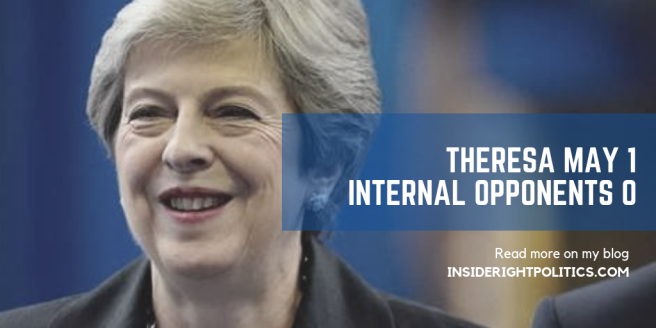
  • What of Theresa May? She is safe until the Autumn (nobody wants her miserable job now) but if we are in a no deal scenario, she will be vulnerable to a desire for a new approach, from a new leader.
  • If the Tories switch leader, with Theresa May departing unwillingly, there will almost certainly be a blood bath and a subsequent General Election. The EU would be forced to extend the transition period.
  • A General Election just might well facilitate, through a party’s manifesto, a second referendum along the lines of Justine Greening’s proposal; preference voting on a new deal, a no deal or stay within the EU.

So the odds:

  • TM as PM until the Autumn, assuming she wants it, 100%
  • TM as PM beyond that to March 2019 70%
  • TM as PM post March 2019 50%
  • A GE in the next 12 months 40%
  • A Labour Government (depending on the scale of bloodletting in the Tory Party) 40%
  • A no deal scenario 20%
  • A second referendum 30%
  • Further damage to the UK’s international standing, its economy, to public life in general 100%.

Time for us all to go on holiday….

Trump may only be the start…

Don’t we love him…Rude, ignorant and brash but what a headline grabber! Insulting your host whilst being wined and dined is quite something. Wandering into Brexit without reading Theresa May’s proposals, praising Boris Johnson and looking forward to a meeting with the vile Putin more than one with his allies, has all been the roller coaster ride we expected.

But when we look back on this period of Trump, almost certainly likely to be 8 years as the Democrats drift to the Left and the US economy roars, it may well be with a degree of nostalgia. Trump is an economic nationalist but he has no process, no coherent philosophy and rarely prepares. He will not make the most of his time in office in terms of changing the world. His ability to shock will diminish and complacent liberal democrats will see him as a one off.

But we should be worried. Because what comes after Trump may be much worse. Read and watch the Steve Bannons of this world. Nationalist, isolationist, attacking even modest political correctness and increasingly organised, they are incubating a hatred of liberal democracy. They loathe those governments perceived to be ‘debasing citizenship’ and central banks that debase currencies. They advocate economic wars and work up many of the average voters with extreme and threatening language.

And the trend, as they say, is their friend. The AfD is flourishing in Germany, as is the far-right in Austria. Radical nationalists are making in-roads into Italian politics whilst populists seize the agenda across Eastern Europe. We have Putin and Brexit. In no particular order one could go on.

Economic nationalism is here to stay as the world order of global cooperation weakens. Liberal democrats seem unable or unwilling to oppose effectively, complacent as they are or simply bogged down with the frustrating minutiae of decent government.

Imagine if a successor to Trump had a plan, a philosophy to unite the forces of nationalist populism without caring about casualties along the way. Smart, organised and with clear convictions, such a leader could make a huge impact.

Many people believe the state of international politics is now direr than it has been for decades. But it could get worse. This may seem bleak but a more coherent, coordinated version of Trump could devastate liberal democracy for a generation.

In this context, an opposing, coordinated force of ‘muscular moderatism’ has never been more needed.


Why the EU matters: Poland

It is easy to miss the point of the EU as the UK enters the final chapter of its interminable, self-harming Brexit negotiations. Its point was hardly addressed either in the Brexit referendum when Project Fear superseded any real desire to make a positive case for Europe.

So let’s turn to Poland as a symbol of why the EU has, and will continue to be, so valuable to Europe’s development despite all the tensions embodied in the current migration crisis.

Populism’s unpleasant forces are felt everywhere from Russia to America via Turkey and Eastern Europe and there seems little that can be done about them since they are at least notionally founded on democratic structures.

Yet, with Poland, where the rise of the populist Law and Justice party (so much irony in the name…) is threatening judicial independence, the EU is making a stand. The Polish Government has just passed measures giving politicians greater powers over the judiciary. It will take control of the National Council of the Judiciary for example, allowing politicians rather than judges to appoint judges. Particularly contentious, it can force the retirement of Supreme Court judges, unless granted an extension by the President, unsurprisingly removing those disliked by the government. They are currently trying to remove Malgorzata Gersdorf, head of the Supreme Court, who has accused the government of seeking to ‘purge’ the judiciary. She is refusing to go.

The EU has had enough. Leaders of EU’s main political parties turned on the Polish Prime Minister, Mateusz Morawiecki, in the EU parliament accusing him of violating the rule of law with these reforms. The European Commission has opened a fresh legal case against Poland this week accusing the country of infringing EU law. This could end up in the European Court of Justice.

The EU had a huge role in ‘democratising’ Eastern Europe as it freed itself from the yoke of the USSR. It was responsible for the spread of democratic law in a part of Europe which could so easily have gone wrong. Hardly a widely understood debating point in the Brexit referendum but it is one of the reasons why those of us supporting Remain are so full of angst at leaving the EU.

As populism spreads to Slovakia and the Czech Republic to name but a few additional countries, threatening those hard fought democratic structures, all exploited equally by China and Russia, who else but the EU is in a position to notice, expose and now try and correct this drift.

What a loss the EU is to the UK and vice versa for so many reasons. Not least because of its role in holding the newer democracies of countries such as Poland to account. This is so important for the whole of Europe including the UK. Sadly, you are unlikely to ever read about it in the final, unthinking chapter of Brexit.

Time for business to take control of Brexit

Matthew Parris was absolutely right in his article in last Saturday’s Times. Only job losses will shift public opinion on Brexit. The two sides of the EU argument are too entrenched for anything else to work.

This was brought home by Saturday’s pro-EU march. It simply passed most people by, hardly worth a significant mention in Sunday’s papers. People are bored and even as a passionate Remainer I felt strangely unmoved. It will have had as much impact as the one million marching against the Iraq war and we all know what happened next. So, as Matthew Parris wrote, it will be events outside politics that will break the deadlock.

And those events may well be the actions of business. Senior executives, provoked into going public by the stupidity of several cabinet ministers, are raising their heads and this could just be the catalyst for the change needed. Airbus first (may pull out of the UK on a no deal scenario), then BMW (8,000 jobs potentially at risk if no agreed customs arrangements) warned of the damage caused if there is no compromise on our trading relationship with Europe. Yesterday, it was announced investment in new cars and plants fell almost 50% in H1 2018 versus the same period last year as investment plans are put on hold. There are some 850,000 jobs relying on our car industry.

And there will be more to come. Economists, even pro-Brexit ones, are highlighting the short term damage to Britain’s economy of Brexit induced uncertainty with forecasting models estimating that the slowdown under way is now costing some £450m a week. So much for the Brexit dividend paying for the NHS…

When Liam Fox was questioned last year on the loss of up to 10,000 City jobs as a result of leaving Europe, he was dismissive describing it as less than expected. He should be forced to meet personally those who lose their livelihoods as a result of Brexit and see how his neo-con, anti-EU ideology resonates with them. We then have our esteemed Foreign Secretary overheard saying F**k business. Well business may just F**k him and it is time it did.

Business groups are coordinating their warnings as frustration mounts at the government’s overall lack of direction, lack of commitment to a frictionless customs arrangement and an insultingly cavalier attitude to potential job losses. Speaking to chief executives yesterday, Theresa May attempted to reassure them of her intentions but why this constant brinkmanship? Companies have had enough of ideologically driven, chaotic EU negotiations.

I have an idea. Like the clock in New York recording the increase in government debt second by second, we should erect a clock in Trafalgar Square recording Brexit induced job losses. It is always the economy stupid, and like a slowly boiling frog the UK must wake up to the cumulative damage of our approach to Brexit before it is too late. Perhaps such an initiative will highlight the actions of business sufficiently to put it in control of a process that politicians have no idea or desire to manage.

Clueless Tories ruin NHS announcement

The Tories have a good story to tell. Sensible stewardship of the economy has allowed further expenditure on the NHS which was crying out for a longer-term funding settlement. All predicated, of course, on finding further efficiencies to ensure every penny counts.

Great news then.

Well, no. The announcement was launched on a Sunday with the explanation that we were benefitting from a Brexit dividend. What was Theresa May thinking? Why dignify the Boris Johnson’s of this world with the claim of a weekly £350m windfall for the NHS post leaving the EU?

It is a manifest untruth. Let’s run through the finances:

  • All official forecasts confirm Brexit worsens rather than improves public finances
  • In particular, the Office for Budget Responsibility (the OBR – the government’s official forecaster) expects Brexit induced slower economic growth will cost £15 billion in lost tax revenues in 2020/21 alone
  • Due to the EU divorce settlement, the UK will be paying contributions for years with only an extra £5.8 billion available to spend elsewhere by 2022/23
  • Even the sum of £5.8 billion is an exaggeration as withdrawing from the EU will require us to replace EU spending – £3 billion on agriculture for example

The Government quickly became a laughing stock and the debate has moved to which taxes will have to rise to fund the announcement. What a mess. The only hope – a valid one – is that the public cease to care where the money comes from as long as it is spent. The immediate polls, however, confirm they saw the untruth a mile away.

Why did this happen? The argument goes that Theresa May was flattering the Brexiteers in advance of an imminent series of humiliating compromises to be made on the terms of leaving the EU. Plausible – it would explain the rushed announcement – but has politics really come to this? Can a Tory Government spending an average 3.4% more on our beloved NHS over 5 years at the same time look like a fool?

The fact that several pro-Brexit commentators are still supporting the Brexit dividend argument simply confirms the toxic, misleading nature of today’s politics. This week, we still have Dominic Grieve’s amendment to be debated in the Commons giving the full House a ‘meaningful vote’ on any EU exit deal. Bring it on…